
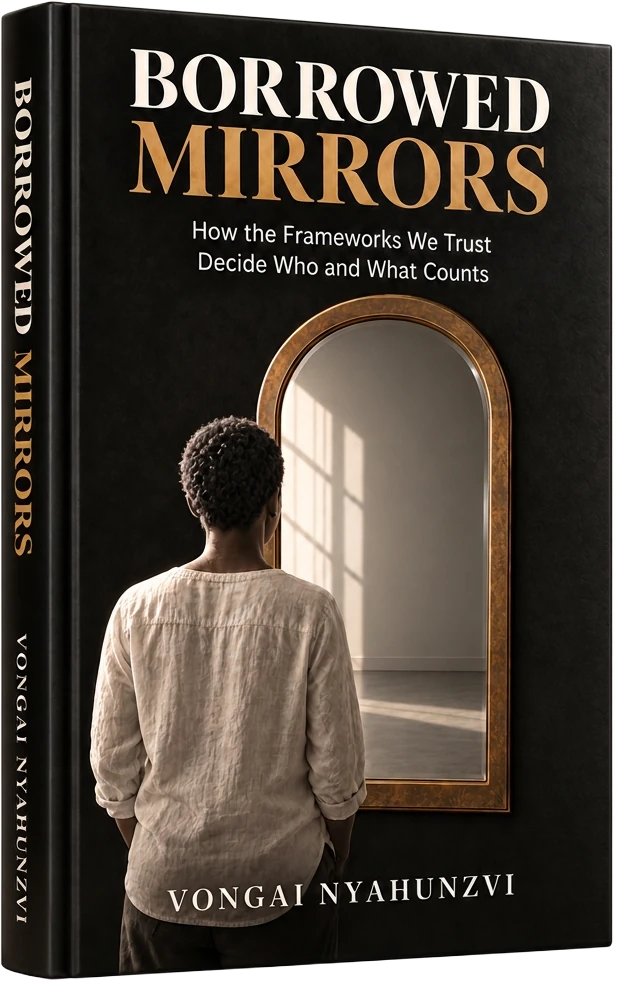
The Book
Borrowed Mirrors
How the Frameworks We Trust Decide Who and What Counts
By Dr Vongai Nyahunzvi
We use frameworks constantly, often without noticing how much authority they have accumulated.
They help employers recognise talent, governments measure progress, funders assess organisations, boards evaluate performance and professions determine what counts as credible evidence.
Most of these tools were created to solve real problems. But a framework can be useful and still be incomplete.
Borrowed Mirrors examines what happens when institutions stop distinguishing between what a framework can see and the whole of what is there.
Available now
Three Questions
Three questions sit at the centre of the book.
Who counts?
How do frameworks shape who appears credible, capable, talented or ready?
What counts?
Which forms of evidence, knowledge, contribution and progress become easier for institutions to recognise?
Who gets to decide?
How do particular frameworks gain authority, and what happens when the people affected by their judgements have limited ability to question the terms?
About the Argument
Borrowed Mirrors moves across leadership, organisational life, governance, development and measurement to examine how systems of judgement become embedded in institutions.
The book does not argue that imported ideas are inherently inappropriate, that local knowledge is automatically superior or that difficult conclusions should be softened in the name of context.
Its argument is narrower and more demanding. Before a framework is allowed to carry a consequential judgement, we should understand what it is capable of seeing, what it may be missing and whether its authority remains justified.
Who should read it
- Leaders and executives responsible for how capability, performance and potential are judged.
- Board members and trustees overseeing consequential institutional decisions.
- Policymakers and public servants who define and measure progress.
- Researchers and evaluators working with evidence, categories and measurement.
- Funders and philanthropic institutions assessing organisations and impact.
- Practitioners and citizens who have felt that a trusted framework was accurate and still incomplete.
Why it matters
- Leadership
- What we recognise as good leadership shapes who is trusted with responsibility.
- Institutions
- Measures shape what organisations are able to notice, reward and improve.
- Policymaking
- Definitions of progress shape which realities receive attention and resources.
- Research
- Categories and forms of evidence determine what can be known and claimed.
- Philanthropy
- Assessment frameworks shape which organisations appear capable and credible.
- Society
- When frameworks acquire unexamined authority, the people they judge may have limited ability to question the terms.
Reading Circles
Read it with others
Borrowed Mirrors is written to be discussed. Borrowed Mirrors Reading Circles bring small groups together, among friends, in book clubs, universities, professional networks or leadership teams, to examine the questions the book raises in their own context. You can start a circle, register interest in joining one, or bring the book into your organisation.
Explore Reading CirclesRead the book. Join the inquiry.
The book is the fullest statement of the argument. The inquiry continues through research, The Reckoning, convenings and institutional conversations.
“The question is not whether we need frameworks. It is what happens when we trust them beyond what they can see.”