
+ The Book is here. The inquiry continues.
Borrowed
Mirrors
How the Frameworks We Trust Decide Who and What Counts
The frameworks we trust shape more than what we measure. They influence whose knowledge is recognised, what counts as capability, which forms of progress appear credible, and who has the authority to decide.
Borrowed Mirrors examines what happens when the instruments through which we judge the world are no longer adequate to the realities they claim to describe.

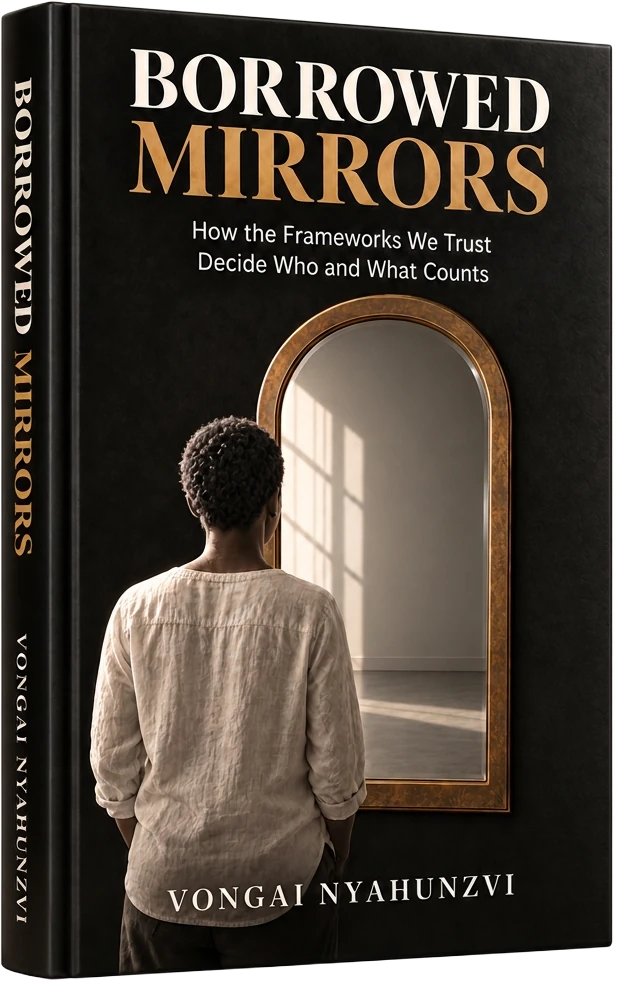
The Book
Borrowed Mirrors
How the Frameworks We Trust Decide Who and What Counts
By Dr Vongai Nyahunzvi
We rely on frameworks to make complex realities understandable. They help us decide what good leadership looks like, what counts as evidence, whether an organisation is capable and what progress should look like.
Borrowed Mirrors asks what happens when those frameworks become so familiar that we stop examining what they were built to recognise, what they may leave outside the frame and how much authority their judgements have acquired.
The book does not argue that frameworks should be abandoned. It asks when they remain adequate for the realities and decisions in front of us.
Available now
Reading with others? Start or join a Reading Circle
The Reckoning
The public intellectual practice of Borrowed Mirrors.
The Condition
This is not a new problem. It is a newly named one.
Frameworks simplify complex realities. That is part of their value.
Difficulty begins when their assumptions become difficult to see and the judgements produced through them are treated as more complete than the evidence allows.
Borrowed Mirrors begins there. It does not assume that the framework is wrong. It asks whether the framework sees enough of the reality in front of it for the decision we are asking it to support.

The Architecture
The Five Distortions
Definition Distortion
One definition of good becomes difficult to see as a choice.
Identity Distortion
People and institutions adapt themselves to what the framework recognises.
Measurement Distortion
The measure begins to stand in for the reality it was designed to track.
Legitimacy Distortion
Recognition by the framework starts to carry more weight than the realities it was meant to serve.
Coherence Distortion
Appearing aligned becomes easier to measure than being aligned.
Recognition
Questions worth noticing
Have you ever encountered a framework that seemed accurate and still incomplete?
What does your organisation currently treat as evidence of success?
Which assumptions inside your most trusted measures have become difficult to see?
These questions point to a recurring tension. What sits outside a framework can sometimes matter as much as what the framework brings into view.
Scope
Where the question appears
The question appears wherever frameworks shape judgement, from how leaders understand capability and performance to how institutions and systems define legitimacy, evidence and progress.
Start here
Four ways into the work
The Book
Explore the argument in its fullest form through Borrowed Mirrors: How the Frameworks We Trust Decide Who and What Counts.
Discover the BookThe Work
See how the inquiry is being applied and tested through institutional work, research and convened conversations.
Explore the WorkThe Reckoning
Follow essays, cases and questions as the thinking develops.
Read The ReckoningBegin a Conversation
Bring a relevant institutional question, research interest or case into conversation with the Borrowed Mirrors team.
Begin a ConversationThe Work
How the inquiry is developing
Institutional Conversations
Borrowed Mirrors can be brought into boards, institutions, universities, foundations and leadership communities through carefully convened conversations around the frameworks shaping consequential decisions.
Explore Institutional Conversations
Research
Building the evidence base through cases, critique, collaboration and questions that are capable of challenging the proposition as well as supporting it.
Explore Research
Convenings
Creating serious spaces in which the argument can be tested against experience, practice and competing perspectives.
Explore Convenings
Writing
Developing the argument through the book, essays, case notes and The Reckoning.
Read the WritingA body of work designed to be tested
Research
Developing a stronger evidence base.
Institutional Conversations
Taking the question into the rooms where consequential decisions are made.
Convenings
Creating spaces for challenge and dialogue.
Learning
Developing ways for leaders and practitioners to work with the ideas responsibly.
Nairobi 2026
The Founding Conversation
On 12 October 2026, more than 140 people from six countries and across multiple sectors gathered in Nairobi to examine a difficult question: how do the frameworks we trust shape who and what counts?
The gathering was not designed to secure agreement. It was an opportunity to question the standards through which we recognise leadership, capability, evidence and legitimacy, and to consider the consequences of getting those judgements wrong.
The gathering was a beginning. The inquiry continues, and there are now several ways to take part, from reading the book with others to hosting a conversation within an institution.
Continue the inquiry
Borrowed Mirrors will develop through cases, questions, research and conversations with people and institutions willing to test the proposition rather than simply agree with it.
If you have encountered a framework that deserves closer examination, are interested in the research, or would like to bring a Borrowed Mirrors conversation into your institution or community, we would welcome the conversation.